
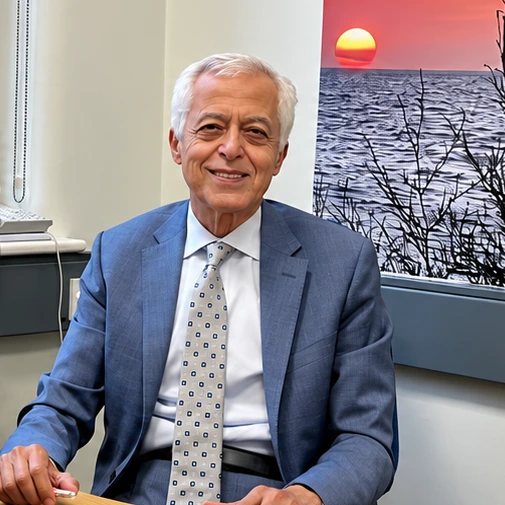
01THE CLINICAL FOUNDATION
A surgeon first.
Professor Habib was born in Cairo in 1952 and qualified in medicine at Ein Shams Medical University there, graduating in 1977. He became a Fellow of the Royal College of Surgeons of Edinburgh in 1981 and took his ChM at the University of Bristol.
His surgical training placed him with two of the defining figures of liver surgery: Henri Bismuth, whose Paris unit shaped modern hepatobiliary practice, and Thomas Starzl in Pittsburgh, who performed the first human liver transplant. That lineage runs through everything that followed — an operative understanding of what the liver can and cannot tolerate.
He was appointed Professor of Hepatobiliary Surgery in the Department of Surgery & Cancer at Imperial College London in 2003, and leads hepatopancreatobiliary surgery on Imperial's Hammersmith campus. In 2007 Imperial appointed him Pro-Rector for Commercial Affairs, a role recognising how much of his work moved from theatre to company.
02SURGICAL INNOVATION
Instruments built for a problem he had met.
Liver resection is constrained by bleeding. The organ is dense with vessels, and the amount of blood lost during an operation shapes both what a surgeon can attempt and how a patient recovers. Professor Habib's response was to change the instrument.
He was the inventor, and co-author on the first publication describing the use of radiofrequency energy in devices for liver surgery. The Habib 4X uses bipolar radiofrequency to seal tissue ahead of the cut, and the technique it enabled is known as Habib's resection. The same principle carried into interventional endoscopy through the Habib EndoHPB and Habib EUS-RFA devices.
The instruments were commercialised through EMcision, the first of the companies he founded — a pattern that repeats: a clinical limit, a device or molecule that addresses it, and a company built to carry it to patients.
03THE RESEARCH ARC
From gene therapy to gene activation.
His published work traces the evolution of cancer molecular biology across four decades: oncogenes and tumour suppressor genes, epigenetic modification, gene therapy, stem cell therapy, and then RNA.
He led the first clinical trial to treat liver cancer with an oncolytic adenovirus delivered by hepatic artery injection, published in 2001. He was the first in Europe to trial autologous stem cell therapy, and the first to apply it in patients with acute stroke and with liver cirrhosis.
Each of those was an attempt at the same question from a different direction: when the liver's own function is the barrier to treatment, can that function be restored rather than replaced?
04SMALL ACTIVATING RNA
Turning a gene up, not off.
Most RNA medicines silence. Small activating RNA does the opposite: short oligonucleotides, chemically similar to siRNA, that increase the expression of a target gene. For a disease of lost function rather than excess, that inversion is the point.
Professor Habib directs the small activating RNA group in Imperial's Department of Surgery & Cancer, whose preclinical work on the CEBPA gene was carried out in the Francis Fraser laboratory on the Hammersmith campus. C/EBP-α is a master regulator of liver and myeloid function, and restoring it became the group's central hypothesis.
He co-founded MiNA Therapeutics to develop the platform, together with Robert Habib, who became its founding chief executive.
05FIRST IN HUMAN
The first saRNA given to a patient.
MTL-CEBPA was the first small activating RNA, and the first drug targeting C/EBP-α, to enter clinical trials. Professor Habib led the study that took it there.
The phase I trial was first-in-human, first-in-class, multicentre and open-label, treating 38 patients with advanced liver cancer across six dose levels from 28 to 160 mg. It was published in Clinical Cancer Research in 2020.
Later studies extended the work: OUTREACH in advanced liver cancer, TIMEPOINT in combination with pembrolizumab across solid tumours, and the international OUTREACH2 expansion.
- OUTREACHNCT02716012
- TIMEPOINTNCT04105335
- OUTREACH2NCT04710641
These are MiNA Therapeutics programmes. Apterna's own lead programme, REGEN001, is preclinical and no clinical claim is made for it.
06THE LILLY COLLABORATION
A platform a major pharmaceutical company bought into.
On 11 May 2021, MiNA Therapeutics and Eli Lilly and Company announced a global research collaboration built on MiNA's small activating RNA platform — the platform founded on the science Professor Habib had developed at Imperial.
Under the agreement MiNA received $25 million upfront and became eligible for up to $245 million in development and commercialisation milestones per target, together with tiered royalties running from low-single to low-double digits on resulting product sales. MiNA would research up to five targets selected by Lilly; Lilly took responsibility for preclinical and clinical development and retained exclusive commercialisation rights.
In July 2021 Lilly followed the collaboration with a direct equity investment in MiNA, reported at approximately $15 million, to advance the company's own pipeline.
Small activating RNAs are a promising new technology, which will expand the breadth of Lilly's RNA therapeutics platform.
Andrew C. Adams, Vice President, Eli Lilly and Company
- Announced
- 11 May 2021
- Upfront
- $25 million
- Milestones
- Up to $245 million per target
- Royalties
- Low-single to low-double digit, tiered
- Targets
- Up to five, selected by Lilly
- Equity
- ≈$15 million, July 2021
The collaboration is MiNA Therapeutics' and not Apterna's. It is recorded here because it is part of Professor Habib's record, not as a partnership of this company.
07COMPANY BUILDING
Six companies, one method.
Professor Habib is a co-founder of EMcision, OmniCyte, MiNA Therapeutics, Apterna, Medeva and Bioenvision. The through-line is consistent: the work begins with a limit encountered in clinical practice, and the company exists to carry the answer far enough to reach patients.
Apterna is the current expression of that method — a liver-directed RNA programme aimed at restoring the function that determines whether a patient can be offered potentially curative surgery at all.
- EMcisionRadiofrequency surgical and endoscopic devices
- OmniCyteStem cell therapeutics
- MiNA TherapeuticsSmall activating RNA platform
- ApternaLiver-directed RNA therapeutics
- MedevaPharmaceuticals
- BioenvisionOncology and biotherapeutics
08RECOGNITION
Acknowledgement of the work.
In December 2012 Professor Habib received the Takreem award for his work in liver cancer and radiofrequency liver resection. He holds honorary academic appointments internationally, and continues to publish across surgery, oncology and nucleic acid therapeutics.
09SELECTED CHRONOLOGY
A record, in order.
- 1952Born in Cairo
- 1977MBBCh, Ein Shams Medical University, Cairo
- 1981FRCS, Royal College of Surgeons of Edinburgh
- 2001Publishes the first oncolytic adenovirus trial in liver cancer
- 2003Appointed Professor of Hepatobiliary Surgery, Imperial College London
- 2007Appointed Pro-Rector for Commercial Affairs, Imperial College London
- 2012Receives the Takreem award
- 2020First-in-human saRNA phase I published in Clinical Cancer Research
- 2021MiNA Therapeutics and Eli Lilly announce their saRNA collaboration
10REFERENCES
Where this comes from.
This profile is compiled from published sources. Each is listed below so any statement on this page can be checked against it.