
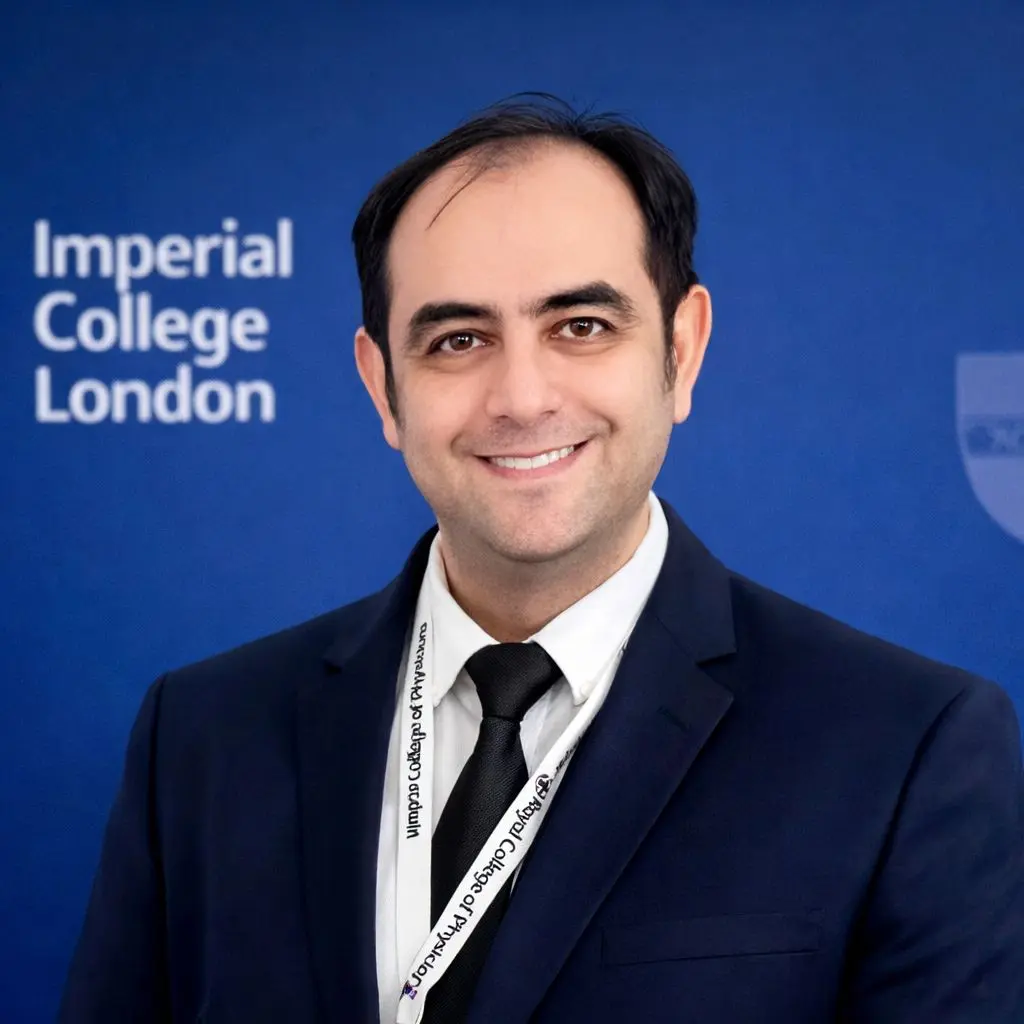
01AN UNUSUAL COMBINATION
Three disciplines, one method.
Dr Dehkordi describes himself as a doctor of medicine, a pure mathematician and a computer scientist. The three are not separate interests but a single working method: clinical questions framed with mathematical precision and answered with computational tools.
His mathematics began at the University of Bath, in category theory and group theory — among the most abstract branches of the subject, concerned with the structure of relationships rather than with particular objects. He then read medicine, graduating from medical school in 2025, and was awarded his MD on 7 July that year.
That combination shapes what he works on. Where a clinician sees a patient cohort and a statistician sees a dataset, the questions he pursues tend to sit between the two: what does a genotype actually predict, and with what certainty.
02CARDIOVASCULAR RESEARCH
What a genotype does and does not tell you.
At the University of Dundee he is an Honorary Fellow (Research) in Neuroscience within the Faculty of Health, based at Ninewells Hospital and Medical School and working in the cardiovascular group in Molecular and Clinical Medicine alongside Dr Anna-Maria Choy and Professor Chim C. Lang.
His primary focus is hypertrophic cardiomyopathy and inherited cardiac conditions: genotype–phenotype correlation, phenotype conversion in family screening, and how disease progresses over time. These are questions about uncertainty as much as biology — a genotype-positive relative who has not yet developed the phenotype presents a problem of prediction, not diagnosis.
The work draws on the Tayside Inherited Cardiac Condition clinic cohort, and the methods are explicitly statistical: survival and mixed-effects modelling, Bayesian hierarchical methods, causal inference and machine learning applied to clinical cardiology data, alongside systematic reviews and meta-analyses conducted to PRISMA standards.
- Hypertrophic cardiomyopathyGenotype–phenotype correlation
- Family screeningPhenotype conversion in relatives
- Heart failureCardio-hepatic axis
03RNA THERAPEUTICS
From the heart to the liver.
At Imperial College London he is a Visiting Researcher in the Department of Surgery & Cancer, working with Professor Nagy Habib on translational approaches to pancreatic and liver disease. His Imperial research keywords are gene and molecular therapy, artificial intelligence, bioinformatics and computational biology, and biomolecular modelling and design.
The work centres on pancreatic ductal adenocarcinoma, liver cancer and liver failure: gene therapy, RNA-based therapeutics, targeted delivery and precision medicine. He is also a co-author on work published in Molecular Therapy — Nucleic Acids on a GalNAc-conjugated siRNA targeting C/EBPβ in a murine model of metabolic dysfunction-associated steatotic liver disease.
The through-line from the cardiovascular work is the cardio-hepatic axis — the recognition that liver function and cardiac function are not independent problems, which is also the premise Apterna's programme rests on.
04METHOD AND TEACHING
Statistics as a clinical instrument.
A recurring theme is that the analysis should be as carefully constructed as the study. His methodological work spans Bayesian hierarchical modelling, causal inference, survival analysis and mixed-effects models, applied to the messy longitudinal data that clinical cohorts actually produce.
At Dundee he teaches medical statistics to junior doctors using SPSS and R, covering data handling, descriptive analysis, logistic regression and survival modelling, with an emphasis on reproducibility — the discipline of making an analysis one that someone else can run again and get the same answer.
- ModellingSurvival, mixed-effects, Bayesian hierarchical
- InferenceCausal inference and machine learning
- Evidence synthesisSystematic review and meta-analysis, PRISMA
- ToolingR · Python · SPSS
05AT APTERNA
Where the disciplines converge.
As Healthcare Innovation Lead, Dr Dehkordi's brief sits where his three disciplines meet: RNA delivery and aptamer chemistry on one side, computational and statistical method on the other, and the clinical question of restoring liver function running between them.
It is the same problem his cardiovascular work approaches from the opposite direction. Apterna's programme asks whether liver function can be restored where it currently limits treatment; his research asks how confidently a genetic finding predicts what a patient will experience. Both are questions about turning a molecular fact into a clinical decision.
Apterna's lead programme, REGEN001, is preclinical. Nothing on this page describes an approved treatment or a demonstrated clinical outcome.
06SELECTED PUBLICATIONS
Published work.
Thirteen publications are listed on his ResearchGate profile, spanning RNA therapeutics, inherited cardiac disease, haematology and clinical audit. A selection follows; the full list is linked in the references below.
- GalNAc-conjugated siRNA targeting C/EBPβ reverses metabolic dysfunction and restores liver homeostasis in a murine MASLD model
- Age-related decline in lymphocyte counts: establishing age-specific reference intervals for clinical practice
- Acute myocardial infarction and antiphospholipid syndrome: an updated systematic review and meta-analysis
- Genotypic influence on phenotypic expression and clinical outcomes in hypertrophic cardiomyopathy: insights from a regional HCM cohort registry
- Phenotype conversion and disease progression in relatives of hypertrophic cardiomyopathy probands: a stratified analysis by genotype status
- Clinical profile and outcomes in hypertrophic cardiomyopathy: findings from the Tayside Inherited Cardiac Condition clinic study
- Serial reticulocyte monitoring after primary spontaneous intracerebral haemorrhage: a novel and scalable window into early erythropoietic failure
07SELECTED CHRONOLOGY
A record, in order.
- 2018Begins medical school
- 2024Joins the cardiovascular group at the University of Dundee
- 2024Cardiovascular and molecular genetic research, Imperial College London
- 2025Awarded MD
- 2026Visiting Researcher, Department of Surgery & Cancer, Imperial
- 2026C/EBPβ siRNA work published in Molecular Therapy — Nucleic Acids
08REFERENCES
Where this comes from.
This profile is compiled from published sources. Each is listed below so any statement on this page can be checked against it.